Can Locals Still Afford Northeast Tennessee Homes? An Honest Q&A About Wages, Prices & the Region’s Future
Can locals still afford to buy a home in Northeast Tennessee in 2026? The honest answer: it has gotten harder, but not impossible. The median household income in Washington County (Johnson City) is roughly $52,000 and in Sullivan County (Kingsport and Bristol) it’s about $48,000, while the median home price across the Tri-Cities is hovering near $300,000. That gap is real, locals feel it every day, and pretending otherwise would be dishonest. But the full picture is more nuanced than a single statistic.
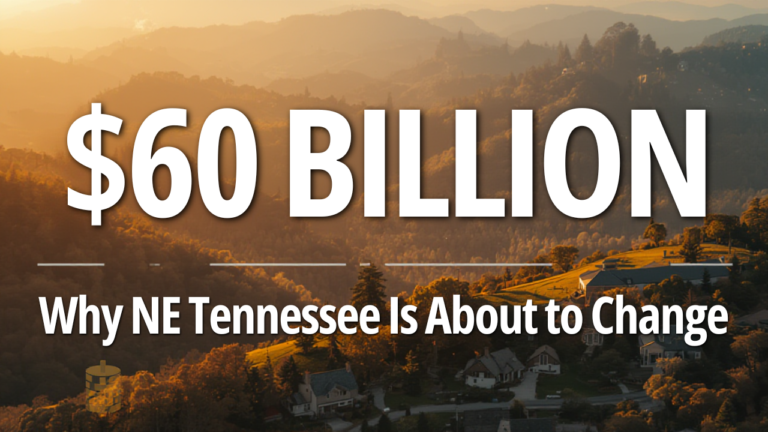
Three weeks ago I posted a video called The $60 Billion Reason Northeast Tennessee Real Estate Is About to Change Forever. It’s been watched more than 18,000 times, and the comment section turned into something I haven’t seen on any of my videos — hundreds of locals, mostly skeptical, pushing back hard on almost every number on screen. I read every single comment, and several deserved a real response. So I made a follow-up video answering the toughest questions, and this is the written companion.
1. Local Wages Don’t Support Local Home Prices — Is That a Problem?
This was the number-one comment theme. The most direct version: “The job market doesn’t support the housing cost. The young people starting out can’t afford $200,000 plus.”
They’re right. Run the math: a $300,000 home with 10% down at 6.5%, plus taxes and insurance, comes to around $2,100 per month. The general guideline is that housing shouldn’t exceed 28% of gross income, so a household earning $50,000 a year — bringing home roughly $4,200 monthly before taxes — can responsibly afford about $1,175 in housing. That’s a home in the $150,000–$170,000 range, not $300,000.
Here’s the nuance. The $60 billion wealth transfer projection isn’t happening because local wages are rising — it’s happening because wealth is arriving from somewhere else. Retirees inheriting from their parents, out-of-state buyers cashing out appreciated homes, baby boomers relocating with 401(k)s and Social Security. That money is buying houses at prices locals genuinely can’t match. For locals who already own, equity is growing significantly. For locals who don’t yet own, the market is harder, but not impossible. Starter homes under $225,000 do exist in parts of Kingsport and Bristol and in smaller towns like Elizabethton, Rogersville, and Erwin — they just require flexibility on size, location, and condition.
2. “Stay Away — You’re Creating the Problem You’re Trying to Escape”
This was the highest-liked comment on the entire video, and I think it deserves more than brushing off. The argument: local infrastructure and healthcare are already behind, and incoming migration is making it worse.
Is infrastructure behind in places? Yes. Johnson City’s North Roan corridor has traffic that didn’t exist five years ago. But there’s also movement — I-26 resurfacing contracts just got awarded (nearly $11 million worth), the Tweetsie Trail is being expanded, Tri-Cities Airport added two new non-stop routes this spring including Chicago, and downtown Kingsport has seen more private investment in the last two years than in the previous ten. That’s not a region standing still — it’s a region catching up. The commenter’s underlying point is still fair: investment tends to be reactive. Roads get widened after the traffic shows up. The time lag is real.
On Ballad Health — the regional hospital monopoly — for routine care most people have a normal experience. For highly specialized care the bench is narrower than in a city with competing systems, and wait times can be longer for certain specialties. That’s a real trade-off.
Where I respectfully disagree is the conclusion. “Stay away or you’ll create the problem you’re escaping” assumes population control is even possible. It isn’t. Every region that tried to freeze its growth — Vermont, Santa Barbara, Boulder, the Bay Area — did so by restricting housing supply, and all of them ended up with less affordable housing, not more. The alternative to managed growth isn’t no growth. It’s decline: empty storefronts, hospitals closing, a shrinking tax base. That’s the set of problems facing many small towns in Appalachia right now, and it’s worse.
3. “We’re Full” — The Feeling of Watching a Hometown Change
Some version of “we’re full” showed up in roughly 20% of the comments. I grew up here, spent 30 years living elsewhere, and moved back to Bristol — so I’m a returning native and technically part of this wave. From the perspective of a lifelong local who never left, I’m part of the problem.
Two things are true at once. One: the feeling of watching your hometown change is real. When you’ve lived somewhere for 40 or 50 years and the restaurant you went to as a kid becomes a wine bar in a $200,000 remodel, you’re not wrong to feel something. You’re grieving a place that seems to be disappearing. Two: the people arriving here are overwhelmingly not villains. They’re retirees leaving Florida because their homeowner’s insurance just hit $9,500 a year. They’re young families leaving California because a starter home costs $1.2 million. They’re Virginia pensioners chasing a lower tax burden. They’re not here to ruin anything — they’re here because their own homes became unlivable and this region is one of the few places where the math still works.
What I tell every out-of-state buyer we work with: if you’re moving here, act like a guest in someone else’s house, because that’s exactly what you are. Shop local, tip well, learn the names of the families that have been here for generations, and don’t complain about the things that make this place feel like itself.
4. Will Northeast Tennessee Home Prices Crash?
Several commenters raised this from different angles. One pointed out that I can’t predict 20 years of real estate trends with certainty — they’re right, and I won’t pretend to. But the $60 billion number isn’t a prediction. It’s an estimate of wealth transfer over a 20-year window based on demographic data. Even if it lands at half of what Core Data projects, it’s still an enormous amount of wealth arriving in a small region over two decades.
What about a 2008-style crash? The 2008 crisis was driven by lending practices that don’t exist today — NINJA loans, liar loans, option ARMs. The 2025–2026 housing market has the highest credit quality of any point in the last 25 years. Homeowners have built significant equity, and foreclosures are running well below historical averages. None of that guarantees prices won’t move, but it makes a 2008-style collapse very unlikely. Prices can soften or stagnate for three to five years while wages catch up — those are possible. A crash is something else, and the data isn’t pointing in that direction.
My best honest guess: prices don’t collapse, but the runaway appreciation we saw from 2021–2023 (8–10% per year) is over. Appreciation is already moderating to 2–4% in Johnson City and closer to flat in Kingsport and Bristol. The region will keep drawing migration, but it won’t be a frenzy. Locals who felt priced out at the worst of 2022 will find the market slightly more accessible over the next couple of years, especially if rates fall.
5. Property Tax Reassessments and the Squeeze on Long-Time Owners
One commenter wrote: “Johnson County is already gouging us with a 75% increase in property value assessment, even though our market doesn’t support that.”
Quick clarification: Johnson County, Tennessee (up near Mountain City) is a different place than Johnson City, Tennessee (in Washington County). Different county, different dynamics. The phenomenon the commenter describes is real across Tennessee though — county property assessments happen on cycles every four to six years and assessed values can jump significantly, even in counties where the market isn’t hot, because reassessments are tied to recent comparable sales. The tax rate is supposed to be adjusted downward to offset, but in practice the offset isn’t always proportional.
For out-of-state buyers, here’s the comparison: Tennessee’s effective property tax rate averages about 0.55%, compared to Virginia at 0.77%, Florida at roughly 0.80–0.90%, and Illinois at 2.07%. Even after a reassessment, Tennessee remains dramatically lower than most states relocating buyers are leaving. But for a long-time homeowner on a fixed income, a 75% jump is a real squeeze regardless of how the rate compares nationally.
The Honest Take
Three weeks ago I thought I was making a market analysis video. What I actually made was a conversation starter, and the conversation in the comments was more valuable than the original video. If you’re local and watching this market change happen around you, I hear you. The wage piece is real. The infrastructure lag is real. The feeling of watching your hometown change is real. I’m not going to pretend otherwise on this channel — ever. If you’re watching from out of state and considering a move, I hope this gave you a more honest picture than the brochure version.
Frequently Asked Questions About Northeast Tennessee Real Estate
What is the median home price in the Tri-Cities area in 2026?
The median home price across the Tri-Cities region is hovering around $300,000 in 2026, though it varies by city. Johnson City is currently near $280,000–$290,000, with Kingsport and Bristol generally a bit lower. Appreciation has moderated from the 8–10% annual pace of 2021–2023 down to roughly 2–4% in Johnson City and closer to flat in Kingsport and Bristol.
Can a local family earning $50,000 still afford to buy in Northeast Tennessee?
Yes, but expectations need to be calibrated. A household earning $50,000 a year can responsibly afford a home priced in the $150,000–$170,000 range, not $300,000. Starter homes under $225,000 do exist in parts of Kingsport, Bristol, Elizabethton, Rogersville, and Erwin, but they require flexibility on size, location, and condition.
Are home prices in Northeast Tennessee going to crash?
A 2008-style crash is very unlikely. The 2008 crisis was driven by lending practices — NINJA loans, liar loans, option ARMs — that don’t exist in today’s market. Credit quality is the highest it’s been in 25 years, homeowners have substantial equity, and foreclosures are running well below historical averages. Prices can soften or stagnate for several years, but a collapse isn’t supported by the current data.
How does Tennessee’s property tax compare to other states?
Tennessee’s effective property tax rate averages about 0.55%, one of the lowest in the country. For comparison, Virginia is around 0.77%, Florida is roughly 0.80–0.90%, and Illinois is 2.07%. Even after a county reassessment cycle, Tennessee’s property tax burden remains dramatically lower than most states relocating buyers are leaving behind.
What’s driving migration into the Tri-Cities region?
Migration is driven by wealth transfer and cost-of-living differentials. Retirees are leaving Florida due to rising insurance costs (some premiums hitting $9,500+ per year), young families are leaving California where starter homes can run $1.2 million, and Virginia pensioners are relocating for a lower tax burden. Inheritance transfers from aging baby boomers are projected to move $60–70 billion through the region between now and 2045 according to Core Data.
Thinking About Moving to Northeast Tennessee?
Whether you’re local, relocating, skeptical, or ready — Kim and I are happy to talk through the real picture, including the trade-offs. We’ll give you the honest version, not the brochure version. Schedule a call with The Home Team at tnvahometeam.com and let’s have an honest conversation about whether this region is the right fit for you.