Northeast Tennessee vs the Carolina Coast for Retirement: Which One Actually Wins? (2026)
By Scott Henninger, MBA | The Home Team, eXp Realty | Updated August 2026
For about fifty years, the default American retirement plan was simple: sell the house and head for the beach. In 2026, more and more of the people sitting across the table from Kim and me are doing the opposite. They looked hard at the Carolina coast, ran the numbers, and picked the mountains instead. So here is the honest short answer: if daily ocean access, flat ground, and non-stop flights are non-negotiable, the coast wins — and South Carolina’s tax picture keeps that from being a crazy choice. But if you want a paid-off house, insurance that doesn’t spike every hurricane season, no state income tax with no fine print, and four real seasons, Northeast Tennessee wins the spreadsheet — and for a lot of folks, it wins the ordinary Tuesdays too.
Here is the number that usually starts the conversation. Homeowners insurance in Myrtle Beach is running roughly $3,000 to $5,000-plus a year before you add flood coverage. Here in Northeast Tennessee, most of our buyers land in the mid-to-low $2,000s or even less. That’s a real bill, every month, forever — and it’s only the first line item. Let’s do the full head-to-head.
House Prices: Coast vs. Mountains
On the coast, the sticker price depends a lot on where and what. In Myrtle Beach, the overall median sits in the $274,000 to $350,000 range according to Zillow — but that number is loaded with condos. Look at single-family homes only and the median is roughly $422,500. Head up to Wilmington, North Carolina, and the median jumps to about $479,000, up more than 5% in the past year. Want to be on the water at Carolina Beach? You’re over $1.2 million.
Now our corner of the map — the Tri-Cities region of Johnson City, Kingsport, and Bristol. The regional median is around $290,000 to $309,000. Johnson City, our priciest market, runs about $348,000 and has been up double digits year over year. Kingsport is around $255,000 to $295,000 and appreciating fast in 2026. So dollar for dollar against Wilmington, you’re buying the same house here for $150,000 to $300,000 less. Against inland Myrtle Beach, the sticker is honestly pretty comparable — which is exactly why the next two sections matter, because the sticker is where coastal costs start and where ours mostly stop.
One more thing the sticker doesn’t show: a lot of coastal inventory is condos with HOA fees that can run several hundred dollars a month, and those associations have been raising fees hard to cover their own insurance. Here, most of what we sell is a house on land you own, with no HOA at all.
Homeowners Insurance: The Retirement Cost Nobody Daydreams About
This is the part that surprises people the most. A standard homeowner’s policy in Myrtle Beach averages somewhere between $3,200 and $5,300 a year depending on the home and coverage. One 2026 analysis put it at about $445 a month — roughly $5,340 a year — for $250,000 of dwelling coverage. That’s about 70% higher than the South Carolina state average, and it’s driven by one word: wind.
And that policy does not cover flood. Storm surge and rising water require a separate flood policy — another substantial annual bill in the high-risk zones near the water. Coastal wind-and-hail deductibles are also often a percentage of your dwelling coverage rather than a flat dollar amount. On a $300,000 home with a 2% wind deductible, that’s $6,000 out of pocket before insurance pays a dime.
Here in Northeast Tennessee, most of our relocating buyers see homeowners quotes in the low-to-mid $2,000s at most — below the national average of roughly $2,500. In Johnson City, the average annual rate is just over $1,800. No hurricane deductibles, and no June-through-November season of watching the forecast, boarding up, and evacuating.
Now, honesty time — the mountains are not risk-free. Hurricane Helene in 2024 flooded parts of our region and western North Carolina badly, and we don’t pretend otherwise. The difference is frequency and insurability: we’re not in the zone where the insurance market itself prices in an annual named-storm season. But do your flood-zone homework here too. That’s true anywhere on the planet with a river.
Taxes: Where South Carolina Actually Holds Its Own
It would be easy to pretend Tennessee wins this in a landslide. It doesn’t. It wins on simplicity.
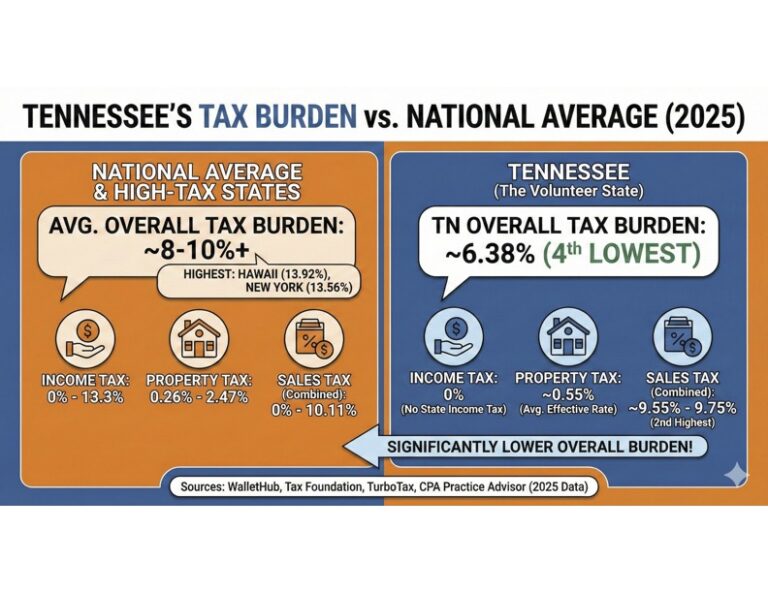
Tennessee has no state income tax, period — not on Social Security, not on your pension, not on 401(k) withdrawals, not on investment income. You never file a state return, and no future legislature has to keep renewing a deduction for you. Property taxes run roughly half to six-tenths of a percent effective, so on a $300,000 home you’re looking at about $1,600 to $1,900 a year depending on county and city. City limits add to that. Where Tennessee gives some of it back is sales tax — combined rates around 9.25% to 9.5% across most of our area, and you’ll feel it on groceries, restaurants, and that new truck.
South Carolina is genuinely retiree-friendly. No tax on Social Security, a retirement-income deduction once you’re 65, a broader senior deduction, and a favorable 4% assessment ratio on owner-occupied homes that keeps primary-residence property taxes low. If your income is mostly Social Security plus modest withdrawals, your South Carolina state tax bill could be small.
North Carolina sits in the middle: Social Security is exempt, but pensions, IRA, and 401(k) income are taxed at a flat 3.99% (scheduled to keep drifting down over the next decade), with no general senior deduction. On $60,000 of non-Social-Security retirement income, that’s roughly $2,500 a year to Raleigh. For most retirees, Tennessee’s math still lands well ahead of North Carolina and roughly even-to-ahead of South Carolina — but if your situation is complicated, that’s a CPA conversation, not a YouTube video.
Everyday Life: Weather, Traffic, Healthcare, and Golf
You’re not buying a vacation — you’re buying Tuesdays. Coastal Carolina summers are long, hot, and humid, with highs in the 80s and 90s and tropical humidity from June into September. Here you get four real seasons: summers mostly in the 80s, a genuine fall, and yes, a winter that snows a few times a year. If never seeing a snowflake again is the whole mission, that’s a point for the beach — I can’t argue Tennessee will meet that goal.
On crowds and traffic: Myrtle Beach hosts something like 18 to 20 million visitors a year, and from Memorial Day to Labor Day the highways and restaurant lines belong to the tourists. Around here, what we call a traffic jam is eight cars behind a tractor. Our tourist surge is Bristol race weekend twice a year, and we just plan our grocery runs around it.
Healthcare matters more at 65-plus, and the Tri-Cities punches above its weight. We’ve got the Ballad Health regional system, a growing med-tech corridor in Johnson City, the VA Medical Center at Mountain Home, and ETSU’s medical school training doctors who can stay here. Coastal healthcare is growing too, but in peak season you’re sharing it with a city’s worth of visitors, and specialist wait times show it.
And golf — Myrtle Beach is one of the golf capitals of the world, no argument. We won’t match the quantity or the high-end quality, but there are courses all over the Tri-Cities with green fees that make Grand Strand golf grin, and you can play them in October without a tee-time lottery.
Where the Coast Wins — and the 6-Hour Rule
We promised to be honest, so here’s the beach’s real case. First, the ocean is the ocean; if walking on the sand at sunrise is your retirement dream, nothing in these mountains replaces it, and you shouldn’t let a spreadsheet talk you out of it. Second, flat ground — coastal living is single-level living on flat terrain, and while we have plenty of one-level homes here, our region has hills that genuinely matter for some mobility situations. Third, flights: Myrtle Beach and Wilmington have more non-stop leisure routes than the Tri-Cities Airport, and Charleston is a couple of hours from the Grand Strand.
Here’s what our transplants figure out, though — I call it the 6-hour rule. From our corner of Northeast Tennessee, you can be at Myrtle Beach or Wrightsville Beach in about six hours, and Charleston in about five and a half. Several of our clients do a beach week every fall, in October when the crowds are gone and the rates drop, then come home to the mountains where their money lives. You can rent a beach condo for a lot of Octobers with the difference in insurance alone.
So Which One Should You Actually Pick?
Here’s the framework, as simple as I can make it. If daily ocean access, flat ground, or non-stop flights are non-negotiable, the coast is your answer — and South Carolina’s tax picture means it’s a reasonable one. But if the mission is a paid-off house, insurance that doesn’t spike every storm season, zero state income tax with no fine print, real seasons, and healthcare that doesn’t run on the tourist calendar, the mountains win the spreadsheet. The beach makes a wonderful vacation. It’s the mortgage, the premiums, and the hurricane season you can skip if you make Northeast Tennessee your home.
Frequently Asked Questions
Is Northeast Tennessee cheaper than the Carolina coast for retirement?
Usually, yes — especially once you get past the sticker price. Tri-Cities median home prices run about $290,000 to $309,000 versus roughly $422,500 for single-family homes in Myrtle Beach and about $479,000 in Wilmington. The bigger gap is insurance: coastal homeowners policies average $3,200 to $5,300-plus a year before flood coverage, while most Northeast Tennessee buyers see quotes in the low-to-mid $2,000s or less.
How much is homeowners insurance in Myrtle Beach compared to Northeast Tennessee?
A standard Myrtle Beach policy averages roughly $3,200 to $5,300 a year — one 2026 analysis pegged it at about $445 a month for $250,000 of dwelling coverage — and that’s before separate flood insurance and percentage-based wind deductibles. In Johnson City, the average homeowners rate is just over $1,800 a year, with no hurricane deductible.
Does Tennessee or South Carolina have lower taxes for retirees?
It depends on your income mix. Tennessee has no state income tax at all — not on Social Security, pensions, 401(k) withdrawals, or investment income — but higher sales tax (about 9.25%–9.5%). South Carolina exempts Social Security and offers senior deductions and a low owner-occupied property assessment, so a retiree living mostly on Social Security and modest withdrawals may owe little there too. Tennessee’s advantage is simplicity: no state return and no fine print. For a complicated situation, talk to a CPA.
Is Northeast Tennessee at risk from hurricanes or flooding?
It’s far lower risk than the coast, but not zero. Hurricane Helene in 2024 flooded parts of the region and western North Carolina. The key difference is frequency and insurability — insurers here don’t price in an annual named-storm season the way coastal markets do. Still, check the flood zone on any property near a river before you buy.
How far is the beach from the Tri-Cities?
About six hours to Myrtle Beach or Wrightsville Beach and roughly five and a half hours to Charleston. Many of our clients keep the mountains as home base and take a beach week each fall when crowds thin and rates drop.
Thinking Through Your Version of the Math?
Kim and I were both born in Bristol, and we’ve helped a lot of folks make exactly this decision — plenty of them coming from the coast. If you want to talk through the real numbers for your situation, with no pressure, reach out. Licensed in both TN and VA.