The Ultimate Guide to Retiring in Northeast TN (Taxes, Healthcare & Homes)
Florida, Tennessee, and Virginia are three of the most popular destinations for retirees on the East Coast — but their tax structures are very different. As a real estate agent who specializes in helping people relocate to Northeast Tennessee, I frequently work with retirees comparing these three states. Here is an honest, side-by-side breakdown of what you will actually pay in each state.
The Quick Summary
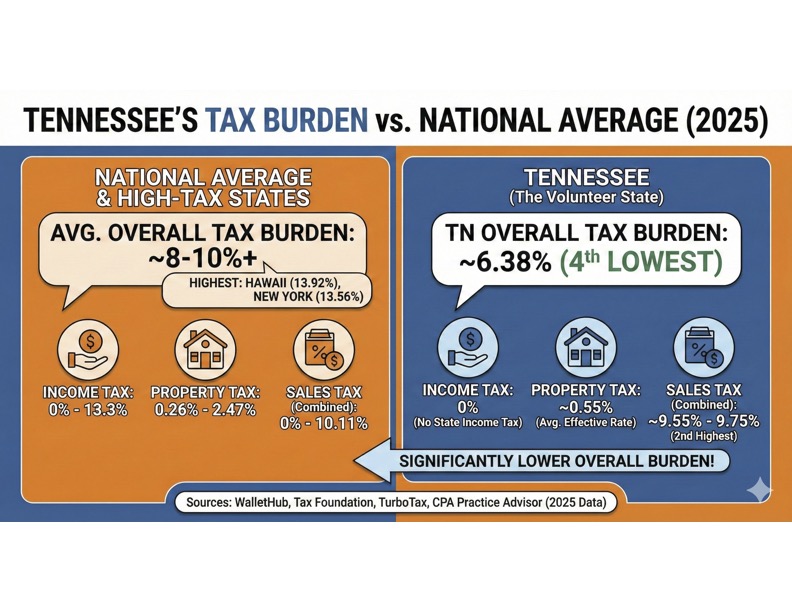
Both Florida and Tennessee have no state income tax, making them the two most tax-friendly options. The key difference between them is cost of living — Tennessee (particularly the Tri-Cities area) offers significantly cheaper housing than most of Florida. Virginia taxes retirement income at rates up to 5.75% and adds a personal property tax on vehicles, making it the most expensive of the three for most retirees.
State Income Tax
Florida: No state income tax. No tax on wages, Social Security, pensions, 401(k) distributions, IRA withdrawals, or investment income. Florida has never had an individual income tax.
Tennessee: No state income tax. Identical to Florida in this regard. Tennessee fully repealed its last remaining income tax (the Hall Tax on interest and dividends) in 2021. Social Security, pensions, retirement account distributions, and investment income are all completely untaxed at the state level.
Virginia: Progressive income tax with rates from 2% to 5.75%. The top rate applies to all taxable income above $17,000 — meaning most retirees with any meaningful income pay near the top rate. Virginia does not tax Social Security benefits, but it does tax pensions, 401(k) distributions, and IRA withdrawals. Taxpayers 65+ can claim a $12,000 deduction, but for a retiree drawing $60,000 from a 401(k), roughly $48,000 would still be taxed — resulting in an annual state tax bill of approximately $2,500 or more.
Property Tax
This is where Florida and Tennessee diverge most significantly — not because of tax rates, but because of home prices.
Florida: Florida’s average effective property tax rate is approximately 0.8%, which is slightly below the national average. However, Florida’s median home prices are substantially higher than Tennessee’s. The median home price statewide is above $400,000 in many desirable areas. Florida offers a homestead exemption of approximately $50,000 (increasing slightly with inflation under Amendment 5) and the Save Our Homes cap that limits annual assessment increases to 3% or the CPI, whichever is lower. On a $400,000 home after the homestead exemption, annual property taxes run roughly $2,800 to $3,500 depending on the county. There is also active legislation (HJR 203) that could significantly reduce or eliminate non-school homestead property taxes starting in 2027, if approved by voters in 2026.
Tennessee (Tri-Cities area): Tennessee has no state property tax. Local property taxes are assessed at 25% of appraised value for residential properties. Effective tax rates in the Bristol and Tri-Cities area generally run between 0.5% and 0.9% of market value. The critical advantage here is home prices: the 2025 Tri-Cities median home price was $280,000, according to the Northeast Tennessee Association of Realtors. On a $280,000 home, annual property taxes typically range from $1,400 to $2,500 — often less than what a Florida retiree pays on a home costing $100,000+ more.
Virginia (Bristol area): Bristol, Virginia’s real estate tax rate is $0.93 per $100 of assessed value at 100% of market value for fiscal year 2025-2026. On a $280,000 home, that is approximately $2,600 per year. Virginia also imposes a personal property tax on vehicles — Bristol, Virginia’s rate is $2.60 per $100 of assessed value, which can add several hundred dollars per year per vehicle. Neither Florida nor Tennessee has this tax.
Sales Tax
Florida: Combined state and average local sales tax rate is approximately 7.06%. Groceries (unprepared food) are exempt from sales tax — a meaningful benefit for everyday spending.
Tennessee: Combined state and local sales tax in Bristol is 9.25% (7% state + 2.25% local). Groceries are taxed at a reduced rate of 6.25% (4% state + 2.25% local). Tennessee’s sales tax is among the highest in the nation — this is the primary way the state funds government without an income tax.
Virginia: Combined sales tax ranges from 5.3% to 7% depending on location. Groceries are taxed at just 1% statewide — the lowest grocery tax of all three states.
Virginia wins on sales tax, Florida wins on groceries, and Tennessee is the highest overall. However, for most retirees, the income tax savings in Tennessee and Florida far outweigh any sales tax difference.
Inheritance and Estate Tax
Florida: No inheritance tax. No state estate tax.
Tennessee: No inheritance tax. No state estate tax. Tennessee repealed its estate tax in 2016.
Virginia: No inheritance tax. No state estate tax.
All three states are equal on this front — none of them will tax your estate or your heirs at the state level.
Cost of Living: The Hidden Factor
Tax rates only tell part of the story. Where Tennessee stands apart from Florida is overall affordability — particularly housing.
Median Home Price Comparison:
Tri-Cities, Tennessee: $280,000 (2025 median, NETAR)
Florida statewide: $400,000+ (varies widely by area)
Bristol, Virginia area: ~$250,000-$290,000
A retiree who sells a $450,000 home in South Florida and buys a comparable home in the Tri-Cities for $280,000 pockets roughly $170,000 in equity — money that can supplement retirement income for years. That arbitrage is one of the biggest reasons retirees are discovering Northeast Tennessee as an alternative to Florida.
Beyond housing, the Tri-Cities area offers lower costs for healthcare, dining, and daily expenses compared to most popular Florida retirement destinations. And unlike much of Florida, Northeast Tennessee has a genuine four-season climate with mild winters — appealing to retirees who want seasons without extreme cold.
Tax Comparison Table: Retiree Earning $60,000/Year from Retirement Accounts
This example assumes a retiree age 65+ with $60,000 in annual income from a 401(k)/pension, owning a home at the area’s median price, and two vehicles worth $25,000 each.
Florida (assuming $400,000 home with homestead exemption)
State income tax: $0
Estimated property tax: ~$3,000
Vehicle personal property tax: $0
Estimated annual state/local tax burden: ~$3,000
Tennessee (assuming $280,000 home in Tri-Cities)
State income tax: $0
Estimated property tax: ~$1,800
Vehicle personal property tax: $0
Estimated annual state/local tax burden: ~$1,800
Virginia (assuming $280,000 home in Bristol, VA)
State income tax: ~$2,500
Estimated property tax: ~$2,600
Vehicle personal property tax: ~$1,300
Estimated annual state/local tax burden: ~$6,400
Tennessee offers the lowest total tax burden in this scenario — roughly $1,200 less per year than Florida and $4,600 less than Virginia. Over a decade, that is $12,000 to $46,000 in additional savings depending on which state you are comparing against. And that is before accounting for the lower home purchase price in Tennessee, which can free up six figures of retirement capital.
The Bottom Line
Both Florida and Tennessee are excellent choices for retirees seeking a low-tax environment. The deciding factors come down to lifestyle and affordability:
Choose Florida if you want beach access, warm weather year-round, and do not mind higher home prices and insurance costs. Florida’s proposed property tax reform (HJR 203) could make it even more attractive if voters approve it in 2026.
Choose Tennessee if you want mountain scenery, four seasons, dramatically lower housing costs, and the ability to stretch your retirement savings further. The Tri-Cities area offers the same zero-income-tax benefit as Florida at a fraction of the housing cost.
Think carefully about Virginia if you are a retiree with significant retirement income. The state income tax and vehicle personal property tax create a meaningfully higher annual tax burden compared to both Florida and Tennessee.
More Resources for Relocators & Retirees
- Bristol TN vs Bristol VA — A detailed breakdown of the tax and lifestyle differences between the two sides of the state line.
- Johnson City TN: Is It a Good Place to Live? — The healthcare hub of the Tri-Cities and a popular choice for active retirees.
- Elizabethton TN: A Hidden Gem — The most affordable community in the region, ideal for retirees on a fixed income.
- Moving to Northeast TN: 9 Things You Need to Know — The practical essentials before you make the move.
Frequently Asked Questions
Does Tennessee or Florida have a state income tax?
Neither state has a state income tax. Both Florida and Tennessee are completely income-tax-free — no tax on wages, Social Security, pensions, 401(k) or IRA distributions, or investment income. They are two of only eight states with no income tax of any kind.
Is Tennessee cheaper than Florida for retirees?
In most cases, yes. While both states have no income tax, Tennessee’s housing costs are significantly lower. The 2025 median home price in the Tri-Cities area of Northeast Tennessee was $280,000, compared to $400,000+ in many popular Florida retirement destinations. Property taxes, insurance costs, and general cost of living are also lower in the Tri-Cities area.
Does Virginia tax retirement income?
Virginia does not tax Social Security benefits. However, it does tax pensions, 401(k) distributions, and IRA withdrawals at rates up to 5.75%. Taxpayers age 65 and older can claim a $12,000 deduction, but most retirees with moderate retirement income will still owe significant state income tax. Virginia also levies a personal property tax on vehicles that neither Florida nor Tennessee has.
What are the advantages of retiring in Northeast Tennessee vs Florida?
Northeast Tennessee offers dramatically lower housing costs, a four-season climate with mild winters, Blue Ridge Mountain scenery, no state income tax, and a lower overall cost of living. Florida offers beach access, warm weather year-round, and a well-established retiree infrastructure. Both states have no income tax and no inheritance tax. The biggest difference is affordability — a retiree’s dollar goes significantly further in Tennessee.
How much can I save by retiring in Tennessee instead of Virginia?
A retiree with $60,000 in annual retirement income, a $280,000 home, and two vehicles could save approximately $4,600 per year in total state and local taxes by living in Tennessee instead of Virginia. Over 10 years, that is roughly $46,000 in savings. The gap grows larger for retirees with higher retirement income or more valuable vehicles.
Considering a Tax-Friendly Retirement in Tennessee?
Scott Henninger specializes in helping retirees from across the country relocate to the Tri-Cities area of Northeast Tennessee. Licensed in both TN and VA.
Contact Scott

2 Comments