South Carolina vs. Tennessee: Which State Should You Actually Move To in 2026?
By Scott Henninger, MBA | The Home Team, eXp Realty | Updated June 2026
If you are deciding between South Carolina and Tennessee in 2026, here is the honest short answer: both are excellent, but they win on different things. South Carolina gives you the ocean, mild short winters, and a slightly lower sales tax. Tennessee gives you zero state income tax, a lower overall cost of living, mountains, and four real seasons. If keeping more of your paycheck and stretching your housing dollar matter most, Tennessee — and especially Northeast Tennessee — has the edge. If your dream has sand in it, South Carolina is hard to beat. Below I break down taxes, home prices, climate, and the growing pains nobody puts on those migration maps.
Everyone Is Moving South — But the Map Doesn’t Tell the Whole Story
You have probably seen the graphic: a map of the U.S. shaded by who is gaining residents and who is losing them. Right now South Carolina is lit up brighter than almost anywhere. For the year ending July 2025, the U.S. Census Bureau says South Carolina was the single fastest-growing state in the country, expanding 1.5% and adding roughly 80,000 new residents in one year. The engine was domestic migration — about 66,600 more people moved in than moved out.
Here is the nuance that map leaves out. South Carolina is number one in percentage growth, but if you rank by the actual number of net movers, the order is North Carolina first, then Texas, then South Carolina — and right behind them, Tennessee, which netted about 42,000 new residents of its own. On the U-Haul migration index, which tracks one-way truck rentals, Tennessee actually ranked ahead of South Carolina for 2025. South Carolina was U-Haul’s number one growth state back in 2024 and is still red-hot. The point is simple: this isn’t South Carolina booming while Tennessee sits empty. The entire Southeast is booming, and these two states are both near the top. The real question is which one fits your life and your budget.
Taxes: Tennessee’s Knockout Punch
This is the category where the gap is biggest. A quick disclaimer — I’m a real estate agent, not an accountant, so confirm your specific situation with a CPA.
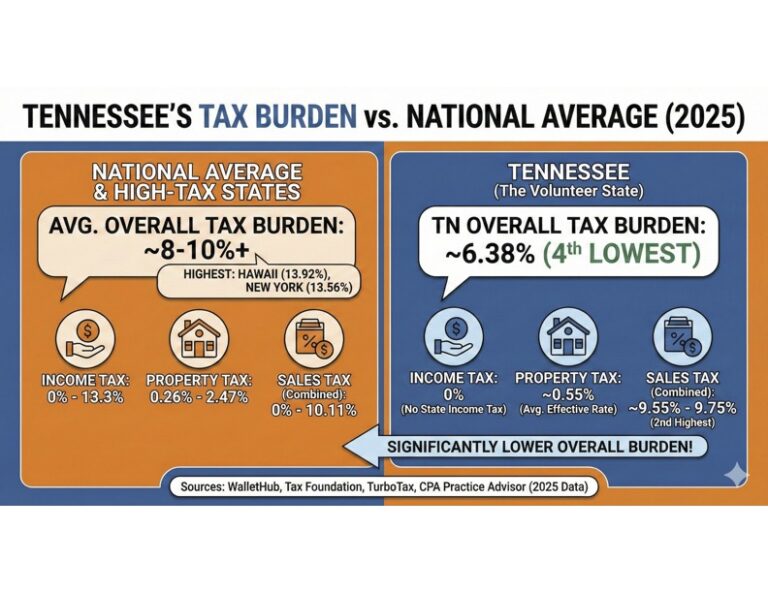
Income tax. Tennessee has no state income tax — not on wages, not on business income, not on pension or IRA withdrawals. Nothing. South Carolina does have an income tax, though it has been cutting it aggressively. After a major reform (H.4216) signed into law this spring, South Carolina now runs about 1.99% on the first $30,000 of taxable income and roughly 5.21% above that for tax year 2026, down from a top rate of around 6%. The law also sets up a framework to keep ratcheting that rate down over time, with the long-term goal of eliminating the income tax entirely. But “lower than it was” still isn’t zero. On a $100,000 income, that difference works out to somewhere around $3,000 or more a year staying in your pocket in Tennessee. For high earners and well-funded retirees, the gap gets a lot bigger.
Property tax. Here South Carolina earns a point. Its effective property tax rate runs around 0.55% versus Tennessee’s roughly 0.7%. Both are low and well below the national average, but South Carolina edges it, and it offers nice homestead exemption breaks for residents 65 and up. The catch a lot of people miss: South Carolina charges an annual vehicle property tax — you pay a tax on your cars every year — which Tennessee does not. That eats into the property-tax savings.
Sales tax. This one leans South Carolina’s way. Tennessee’s combined state-and-local rate runs around 9.5%. South Carolina’s state rate is 6%, with local add-ons putting most areas around 7.5% and up to 9% in a few spots. So on day-to-day purchases, South Carolina is generally a bit cheaper at the register.
Bottom line on taxes: If income tax matters to you — and if you’re a high earner, a remote worker, or a retiree drawing real income, it matters a lot — Tennessee wins this category, and it isn’t close. South Carolina’s property and sales tax edges are real but smaller, and the vehicle tax claws some of it back.
Home Prices and Cost of Living
Statewide, South Carolina’s home values run around $308,000 (Zillow), with recent median sale prices closer to $350,000. But statewide numbers hide a huge spread, and where you land changes everything:
- Charleston — gorgeous, and expensive. Typical home values sit around $525,000, with recent median sale prices pushing into the $600,000s.
- Myrtle Beach and the coast — prices swing widely based on how close to the water you are.
- Greenville — much more reasonable, with a median around $310,000. Keep this one in your back pocket: it’s only about 90 minutes from us here in the Tri-Cities. These regions practically touch.
Now compare that to Northeast Tennessee. Median home prices across the Tri-Cities — Johnson City, Kingsport, and Bristol — run from the high $200,000s to the high $300,000s depending on the city. Johnson City’s recent median sale price is around $339,000, Kingsport sits closer to $293,000–$315,000, and the Bristol-Kingsport side runs just under $290,000. Against coastal South Carolina, Northeast Tennessee is dramatically cheaper. Against Greenville, we’re comparable to a bit cheaper.
Cost of living tells the same story. South Carolina runs about 6% below the national average, while Northeast Tennessee runs more like 10–15% below. Both beat where most transplants are coming from, but Tennessee — and Northeast Tennessee especially — generally stretches your dollar further than the parts of South Carolina people actually want to move to.
Bottom line on cost: South Carolina is affordable until you chase the coast, then it gets pricey fast. Northeast Tennessee keeps housing and everyday costs lower across the board. If maximizing what your dollar buys is the priority, Tennessee has the edge.
Climate and Lifestyle: Beaches vs. Mountains
This is where it stops being about spreadsheets and starts being about the life you actually want — and for a lot of people, this is the category that decides it.
If I had to describe each place in one word, South Carolina is the ocean. You’ve got Charleston, one of the most beautiful historic cities in America, plus Myrtle Beach, Hilton Head, and miles of Atlantic coastline. Winters are mild and short. If your dream is warm weather most of the year, sand between your toes, and golf in February, South Carolina delivers in a way Tennessee simply can’t, and I won’t pretend otherwise. The honest trade-offs: summers are very hot and humid, and the coast carries a real hurricane and flood risk that has become a genuine cost and insurance consideration.
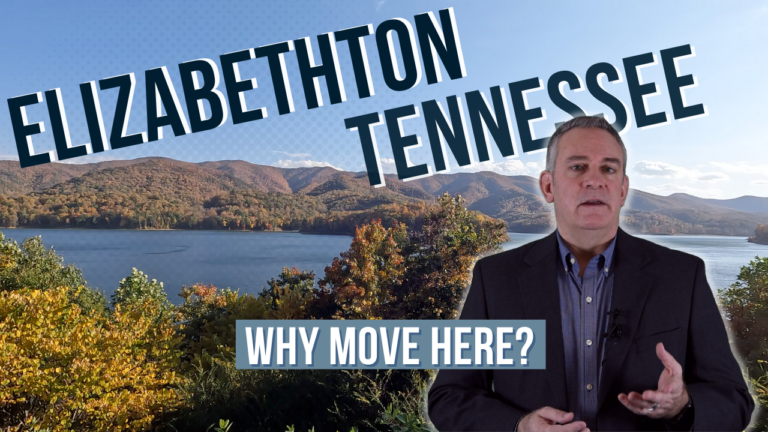
Northeast Tennessee is the mountains. We’ve got the Appalachian Highlands, the lakes — South Holston, Watauga, Boone — rivers, trails, and four true seasons. You get a real but mild winter, a gorgeous spring and fall, and summers that are warm but more comfortable at our elevation than the Deep South coast. We’re tucked inland, so hurricanes aren’t the threat they are on the coast. The trade-off is on us too: if you need the beach and hate the cold, even our mild winters may not be for you.
And here’s the “why not both” angle I love. From Northeast Tennessee, you can be on the South Carolina coast — Charleston or Myrtle Beach — in about five and a half to six hours. A lot of our folks live up here in the mountains with low taxes and low cost of living and still road-trip to the beach a few times a year. You don’t always have to choose.
The Growing Pains Nobody Talks About
Here’s the part those migration maps never show you: what happens after everybody moves in. South Carolina’s growth is incredibly concentrated — more than 80% of the state’s gain has landed in about 10 counties: Charleston, Greenville, Horry County around Myrtle Beach, and the Charlotte-border counties like York and Lancaster. When that many people pour into a handful of places that fast, you get the side effects: traffic, strained infrastructure, rising home prices, and that “this place doesn’t feel like it did five years ago” feeling from longtime locals. If you move to a South Carolina boom town, understand that you’re moving into the boom, crowds and all.
Tennessee has growth too — no question. But Northeast Tennessee specifically has stayed more under the radar. We’re growing steadily, not explosively, which is honestly part of the appeal. You get the benefits of a desirable, appreciating area without the full traffic-and-crowding tax the hottest South Carolina metros are paying right now. Our commutes are still 15 to 20 minutes — and that’s getting rare in a lot of the places topping those maps. Growth isn’t bad; appreciation is good for your home’s value and new amenities are good. I’m just telling you to look past the headline and ask: do I want to be in the eye of the storm, or just close enough to enjoy it?
So Who Should Pick Which State?
Pick South Carolina if: the beach and the ocean are non-negotiable; you want mild, short winters and warm weather most of the year; Charleston’s history and culture or Myrtle Beach’s coastal lifestyle is your dream; and you’re okay trading a bit more cost and a state income tax for that coastline. If you want the South Carolina vibe with more affordability — and to stay close to us — look hard at Greenville and the Upstate.
Pick Tennessee, especially Northeast Tennessee, if: no state income tax is a big deal for you (it should be if you’re earning or drawing a real income); you want the lowest cost of living and the most house for your money; you love mountains, lakes, and four real seasons; you’d rather live in a steadily growing area than a packed boom town; and you like the idea of keeping the beach as a road trip rather than a daily reality.
Here’s what I tell everybody: there’s no wrong answer when you’re choosing between two of the most wanted states in the country. You’re choosing between mountains and ocean, between zero income tax and the coastline. Both are great. The only real question is which one matches the life you’re actually picturing.
Frequently Asked Questions
Is Tennessee or South Carolina better for taxes?
For income taxes, Tennessee is clearly better — it has no state income tax on wages, business income, or retirement withdrawals. South Carolina has an income tax, though a 2026 reform lowered it to about 1.99% on the first $30,000 of taxable income and roughly 5.21% above that, with a long-term goal of eliminating it. South Carolina does have slightly lower property taxes (about 0.55% vs. Tennessee’s 0.7%) and a lower sales tax, but it also charges an annual vehicle property tax that Tennessee does not. For most high earners and retirees, Tennessee comes out ahead overall.
Is South Carolina or Tennessee cheaper to live in?
Both are affordable, but Tennessee generally stretches your dollar further. South Carolina’s cost of living runs about 6% below the national average, while Northeast Tennessee runs roughly 10–15% below. Statewide South Carolina home values are around $308,000, but desirable coastal areas like Charleston push past $525,000. Northeast Tennessee’s Tri-Cities (Johnson City, Kingsport, Bristol) generally range from the high $200,000s to high $300,000s.
Why is South Carolina growing so fast?
South Carolina was the fastest-growing state in the country for the year ending July 2025, expanding 1.5% and adding nearly 80,000 residents — almost entirely from domestic migration. People are drawn by the coastline, mild winters, a relatively low cost of living, and expanding healthcare and tech jobs in metros like Greenville and Columbia. More than 80% of that growth, however, has concentrated in about 10 counties, which brings traffic and rising prices to those specific areas.
How far is Northeast Tennessee from the South Carolina coast?
It’s about a five-and-a-half to six-hour drive from the Tri-Cities to Charleston or Myrtle Beach. That makes it realistic to live in the Northeast Tennessee mountains with low taxes and a low cost of living while still taking beach road trips a few times a year. Greenville, in the South Carolina Upstate, is even closer — only about 90 minutes away.
Is Northeast Tennessee a good alternative to South Carolina?
For many relocators, yes. Northeast Tennessee offers no state income tax, a lower cost of living, mountains and lakes, four real seasons, and steadier growth without the traffic and crowding hitting South Carolina’s hottest metros. The trade-off is that you don’t get the ocean or the mild coastal winters. If the beach is non-negotiable, South Carolina wins; if taxes, affordability, and a calmer pace matter more, Northeast Tennessee is a strong fit.
Thinking About a Move to Northeast Tennessee?
If you’re leaning toward Tennessee and want to talk through where up here actually fits you, your budget, and your lifestyle, that’s exactly what Kim and I do — with zero pressure. Scott Henninger helps out-of-state buyers find the right home and the right community in the Tri-Cities. Licensed in both TN and VA.